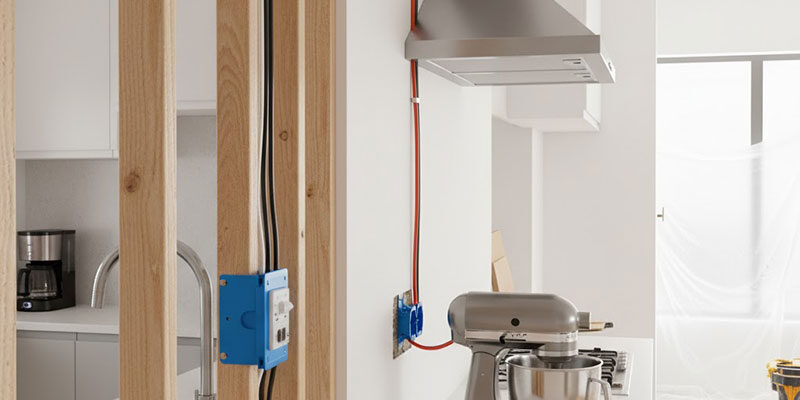
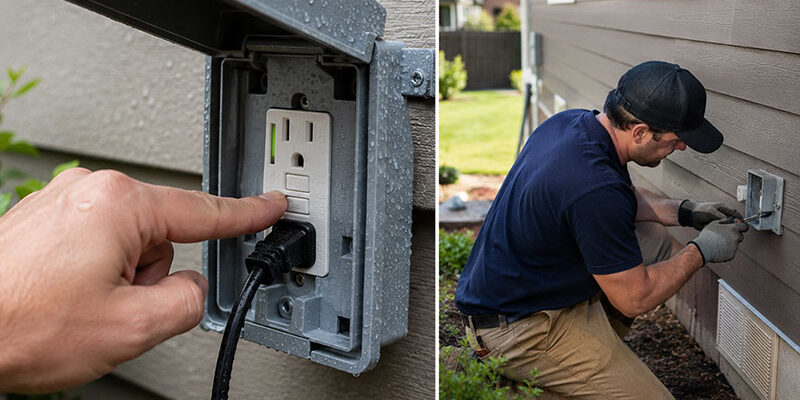
A well-placed exterior outlet changes how you use your backyard. It powers tools, lighting, patio speakers, outdoor kitchens, and everything else that makes an outdoor space actually usable, and it does it without a single extension cord snaking across the yard.
But adding an outdoor receptacle is more than cutting an opening in a wall and connecting to the nearest indoor outlet. We have to think through circuit capacity, grounding, GFCI protection, weather exposure, approved wiring methods, physical protection, permit requirements, and what the outlet will actually be powering, both now and down the road.
That planning matters most when the outlet is meant for high-demand appliances, a detached structure, a pool or spa, an outdoor kitchen, or anything that will stay plugged in for long stretches of time.
Why Exterior Outlet Installation Requires Careful Planning
A lot of homeowners come to us with a location already picked out, but no real plan for what’s going to plug into it. That usually ends with a receptacle that’s inconveniently placed, wired to an already-busy circuit, or simply not built for the equipment that ends up using it.
Before we start any exterior outlet installation, we like to work through a few questions with the homeowner:
- What equipment will use the outlet?
- How much power will that equipment require?
- Will the use be temporary, seasonal, frequent, or continuous?
- Will the outlet be exposed to rain or irrigation?
- Could a connected cord cross a walkway or landscaped area?
- Is the location close to a pool, spa, fountain, or other water source?
- Will a dedicated circuit be needed?
- Could landscaping, vehicles, or tools damage the outlet?
- Are additional electrical projects planned for the same area?
The answers shape everything that follows, including the location, the circuit, the wiring method, the enclosure, and the protective devices.
Sacramento Electrical Code Requirements for Outdoor Outlets
Electrical work in the Sacramento area falls under the California Electrical Code, along with locally adopted requirements and administrative procedures. The National Electrical Code lays the groundwork for a lot of these standards, but permits and inspections are handled by whichever authority has jurisdiction over your particular property.
That authority might be the City of Sacramento, Sacramento County, Placer County, or another incorporated city nearby. It’s worth confirming the requirements for your property’s actual location rather than assuming every project in the greater Sacramento area follows the same permitting process, because that’s not always the case.
GFCI Protection
Outdoor receptacles generally require ground-fault circuit-interrupter protection. That GFCI can be built into the receptacle itself, located earlier on the same branch circuit, or provided through a circuit breaker in the panel.
GFCI protection interrupts power the moment electricity starts traveling along a path it shouldn’t be on. That matters a lot outdoors, where people are often in contact with wet concrete, soil, metal equipment, or water.
Our companion article on outdoor GFCI outlets and weatherproofing walks through how this protection works, how to test it, and why outdoor devices sometimes trip during rain.
Weather-Resistant Receptacles
Receptacles installed in exterior damp or wet locations have to be suitable for that environment. Weather-resistant receptacles are commonly identified by a “WR” marking, and they’re built with materials designed to hold up better against moisture, corrosion, sunlight, and temperature changes.
Ground-fault protection and weather resistance do two different jobs. A GFCI responds to an electrical imbalance, while a weather-resistant device is built to physically endure outdoor conditions over time.
Weatherproof Boxes and Covers
The receptacle needs to sit in an approved electrical box with a properly fitted cover and gasket. Which cover is right depends partly on whether the outlet will only be used occasionally or stay connected to equipment.
When a cord is going to stay plugged in, a while-in-use cover protects the connection while still letting the cord exit the enclosure. A flat cover that’s only weatherproof when closed doesn’t offer much protection while it’s actually being used.
Grounding and Circuit Protection
Exterior outlets have to be properly grounded and tied to correctly sized conductors and overcurrent protection. Installing a bigger breaker to handle more demand, without first verifying the wiring can actually support it, is a shortcut that leads to real problems.
We always evaluate the existing panel and branch circuit before adding new loads. Older homes in particular tend to have limited capacity, crowded panels, aging wiring, or circuits that already serve several indoor and outdoor areas at once.
If you’re dealing with limited capacity or breaker problems that keep coming back, our guide on signs an electrical panel may need an upgrade is worth a read.
Tamper-Resistant Receptacles
Tamper-resistant receptacles are also commonly required in residential settings. These have internal shutters that help keep foreign objects from being pushed into just one slot, and they’re identified by a “TR” marking.
The right combination of GFCI protection, weather resistance, tamper resistance, enclosure, and cover comes down to current code and the outlet’s specific location. It’s rarely one-size-fits-all.
Does Adding an Outdoor Outlet Require a Permit?
Often, yes. Adding a new receptacle, extending a branch circuit, installing new wiring, trenching for underground power, or adding a dedicated circuit can all require an electrical permit and inspection. The exact requirements vary by jurisdiction and the scope of the project.
Replacing a damaged device in the same location may be treated differently from installing new wiring or changing a circuit. Don’t assume a small project is automatically exempt just because it looks minor from the outside.
Why Electrical Permits and Inspections Matter
It’s easy to think of permits as just paperwork, but the process actually serves a real purpose:
- It documents electrical improvements to the property.
- It allows concealed wiring to be inspected before walls or trenches are closed.
- It confirms that required protective measures were included.
- It can help prevent complications during a future sale or insurance claim.
- It provides independent review of work involving shock and fire hazards.
A licensed electrician who knows the local jurisdiction can tell you whether a permit is needed and coordinate inspections when it is.
Understanding the Authority Having Jurisdiction
The phrase “authority having jurisdiction” refers to whichever local agency is responsible for interpreting and enforcing the building and electrical requirements that apply to your property.
A Sacramento mailing address doesn’t always mean a property falls within the City of Sacramento. It might sit in unincorporated Sacramento County or another nearby jurisdiction, and that distinction can change the application process, fees, inspections, and adopted amendments that apply to your project.
Choosing the Best Location for an Exterior Outlet
Code compliance sets the minimum safety bar, but good planning also accounts for convenience and how people actually use the space.
An outlet should be reachable without running cords across doorways, steps, paths, or wherever people tend to gather. It also needs to stay visible once landscaping fills in, and reasonably protected from sprinklers, vehicles, lawn equipment, and other everyday sources of damage.
Patios and Outdoor Living Areas
Patio outlets typically support lighting, small appliances, televisions, speakers, fans, laptop chargers, and cleaning equipment. Placing receptacles near where furniture or equipment will actually sit helps keep cords off the walking path.
Covered patios still need components suitable for the damp or wet conditions they actually experience. Roof coverage alone doesn’t turn an outdoor location into an indoor one.
Outdoor Kitchens and Barbecue Areas
Outdoor kitchens can require several circuits for refrigerators, beverage coolers, grills, warming equipment, lighting, ventilation, and general convenience receptacles.
This kind of planning should start before counters, cabinets, masonry, or plumbing go in. Doing it early lets us place outlets and dedicated circuits according to the actual equipment specs, while keeping cords away from heat and water.
Gardens and Landscaping
Well-placed outlets can support landscape maintenance, irrigation controls, water features, holiday decorations, and outdoor lighting. It helps to choose locations with future plant growth and irrigation coverage already in mind.
If you’re planning illumination rather than general-purpose power, our guide to outdoor lighting design for Sacramento properties is the better starting point.
Garages, Sheds, and Workshops
A detached garage, shed, or workshop often needs more than a simple extension of an existing circuit. Tools, lighting, refrigeration, battery chargers, ventilation, and future equipment add up to meaningful electrical demand fast.
Depending on the structure and how it’ll be used, this can involve a feeder, subpanel, disconnecting means, grounding provisions, trenching, and multiple branch circuits.
Similar planning applies to accessory dwelling units. Our guide to ADU electrical requirements in Greater Sacramento covers how load calculations, panels, circuits, permits, and inspections factor into a larger residential addition.
Driveways and Vehicle Areas
Outlets near driveways come in handy for power tools, vacuums, maintenance equipment, or occasional Level 1 vehicle charging. That said, an ordinary receptacle shouldn’t be mistaken for a properly planned charging solution.
If you’re regularly charging an electric vehicle, it’s worth having a dedicated installation designed around the vehicle and your panel’s available capacity. Magic Sun Electric provides EV charging station installation throughout Greater Sacramento and Placer County.
When an Outdoor Outlet Needs a Dedicated Circuit
A new outlet can sometimes tie into an existing branch circuit, but that doesn’t automatically make it the right call. It comes down to the existing load, circuit rating, wiring, equipment requirements, and how the outlet will actually be used.
Equipment that often needs dedicated or specially planned power includes:
- Outdoor refrigerators and freezers
- Electric grills and cooking appliances
- Patio heaters
- Pool and spa equipment
- Pumps and water features
- Workshop tools and compressors
- Motorized gates
- Large landscape lighting systems
- Electric vehicle charging equipment
Large appliances often come with manufacturer instructions that spell out voltage, amperage, circuit size, GFCI protection, disconnects, or hardwired connections. We design around those specific requirements rather than treating every outdoor load the same way.
For a broader look at circuit planning, see our article on dedicated circuits and GFCI outlets.
Safe Outdoor Wiring Methods
Wiring approved for dry indoor walls isn’t automatically approved for exterior, underground, or wet locations. Outdoor wiring methods have to account for moisture, sunlight, temperature, corrosion, and physical damage all at once.
Above-Ground Conduit and Wiring
Surface-mounted exterior wiring generally requires approved conduit, fittings, boxes, and conductors. The conduit has to be properly supported and protected anywhere it could be struck by yard equipment, tools, vehicles, or stored materials.
Fittings and transitions matter just as much as the conduit itself. An installation can still let moisture in even when the visible conduit looks perfectly intact.
Underground Electrical Wiring
Underground raceways are treated as wet environments because moisture can enter through condensation or the surrounding soil. Conductors and cable have to be rated for that application.
Burial depth and protection requirements vary depending on the wiring method, circuit characteristics, and location. Wiring often needs extra protection where it comes up out of the ground or passes through areas exposed to damage.
We also factor in:
- Irrigation lines
- Drainage systems
- Tree roots
- Future landscaping
- Driveways and vehicle traffic
- Other buried utilities
Underground utilities should always be located before digging starts, and a permit and inspection may be required before a trench gets filled back in.
Wiring Through Exterior Walls
Penetrations through siding, stucco, masonry, or other exterior materials need to be done carefully. The electrical box has to be secure, and the opening has to be protected against water intrusion without trapping moisture inside the wall or enclosure in the process.
Exterior wall construction can significantly affect how long the job takes. Access is often straightforward when an indoor receptacle sits directly behind the proposed outdoor outlet, but the existing circuit still needs to be evaluated before we extend it.
Outdoor Outlets Near Pools, Spas, and Water Features
Pools, spas, fountains, and similar installations come with additional electrical requirements that go well beyond receptacle covers and GFCI devices. Depending on the setup, these can include separation distances, bonding, grounding, disconnects, equipment ratings, wiring methods, and specialized protection.
Outdoor electrical work near water should be planned as part of the complete pool, spa, or water-feature system, not added on later just for convenience without checking how the location relates to the water and its equipment.
Manufacturer requirements and the local inspector’s interpretation both come into play here too, which is why we don’t apply universal placement measurements to every project without confirming the current code and actual installation conditions first.
Common Exterior Outlet Installation Mistakes
A receptacle can look and act completely normal while still being improperly installed underneath. The mistakes we see most often include:
- Extending an already overloaded circuit
- Installing an indoor receptacle in an exterior location
- Failing to provide or verify GFCI protection
- Using an unsuitable box, gasket, or cover
- Installing a flat cover where equipment remains plugged in
- Using conductors or cable not approved for a wet location
- Failing to protect exposed conduit from physical damage
- Using an oversized breaker for existing wiring
- Placing an outlet in the direct path of irrigation
- Installing it where cords cross a walkway
- Ignoring permit and inspection requirements
- Adding power without considering future outdoor equipment
Another mistake we run into often is assuming any outlet can support any appliance. A receptacle can have the correct plug configuration while the circuit behind it lacks the capacity the equipment actually needs.
Extension Cords Are Not a Permanent Solution
If you find yourself constantly reaching for outdoor extension cords, that’s usually a sign the property needs additional permanent outlets. Cords routed through doors, windows, landscaped areas, or walking paths are vulnerable to damage and create real tripping hazards.
A permanent exterior outlet installation puts power exactly where it’s needed, with the grounding, weather protection, and circuit capacity to match.
Until permanent power is in place, stick to outdoor-rated extension cords used only temporarily and within their listed capacity. Keep connections away from standing water, and retire damaged cords instead of taping them up and putting them back into service.
What Affects Exterior Outlet Installation Cost?
The cost of adding an exterior outlet depends on a lot more than the receptacle itself. Two installations that look nearly identical from outside can require very different amounts of labor and material.
The biggest cost factors we account for include:
- Distance from the electrical panel or available circuit
- Whether an existing circuit has adequate capacity
- Need for a new dedicated circuit
- Accessibility above ceilings, beneath floors, or inside walls
- Stucco, masonry, siding, and other exterior materials
- Surface-mounted conduit versus concealed wiring
- Trenching and underground wiring
- Required weatherproof boxes and covers
- Panel capacity and available breaker spaces
- Permit and inspection requirements
- Distance from pools, spas, or water features
- Repairs needed after previous improper work
The cheapest location isn’t always the best one. An outlet placed purely to minimize labor, but that leaves cords crossing the patio every time it’s used, tends to be a decision homeowners regret later.
Planning for Future Outdoor Electrical Needs
Outdoor projects tend to happen in stages. A homeowner might start with a single receptacle for tools, then add lighting, a patio cover, outdoor cooking equipment, a spa, a workshop, or an EV down the line.
Talking through your future plans with us upfront can save you from paying for the same work twice. Sometimes it makes sense to run extra conduit, choose a smarter circuit route, reserve panel capacity, or position outlets so they can support improvements you haven’t made yet.
Smart switches, timers, sensors, and automated controls can also be worked into some exterior electrical projects. Our overview of smart home electrical systems covers how connected controls can improve convenience, scheduling, security, and energy management.
If you’re planning broader improvements, it’s also worth reviewing the electrical upgrades that can improve property value. Safe, conveniently located outlets might be a small part of a larger project, but they make a real difference in how usable an outdoor space actually is.
Frequently Asked Questions About Exterior Outlet Installation
Can an exterior outlet be connected to an indoor outlet?
Sometimes, by extending an existing branch circuit, but we always evaluate the circuit type, wiring, grounding, capacity, protective devices, and current load first. Physical proximity to an indoor outlet doesn’t make it an appropriate power source on its own.
Does every exterior outlet need its own circuit?
No, not always. General-purpose outdoor receptacles can sometimes share a suitable branch circuit. High-demand appliances and equipment, on the other hand, may need dedicated circuits based on electrical load, code requirements, or manufacturer instructions.
Do I need a permit to add an outdoor outlet in Sacramento?
Often, yes. New wiring, circuit extensions, and dedicated circuits may all require permits and inspections. It depends on the project and whether the property falls under the City of Sacramento, Sacramento County, Placer County, or another local jurisdiction.
Can an outlet be installed directly on stucco?
Yes, but the box has to be securely mounted, and the installation has to protect the wall penetration from moisture. Uneven or damaged stucco can make proper mounting and sealing noticeably harder.
Can I add an outlet to a detached shed?
Yes, though powering a detached structure can involve underground wiring, a feeder or branch circuit, grounding, a disconnect, permits, and protection from physical damage. The right approach depends entirely on how the structure will be used.
Can I use an outdoor outlet for an electric vehicle?
Some vehicles can charge from an appropriate 120-volt receptacle, but continuous vehicle charging places real demand on a circuit. The receptacle, wiring, circuit capacity, and manufacturer requirements all need to be evaluated first. Regular charging is better handled as a dedicated EV charging project rather than an incidental use of an outdoor outlet.
How many outdoor outlets should a home have?
Code sets a minimum, but the right number really depends on your property size and how you use the outdoor space. Strategic placement can cut down on extension cord use and support patios, front yards, gardens, workshops, and seasonal lighting.
Can I install an exterior outlet myself?
We’d steer you away from it. Exterior electrical work carries real risks around shock, fire, moisture intrusion, grounding, circuit loading, and code compliance. New wiring and circuit modifications should go to someone qualified to evaluate the complete installation and pull the required permits.
Professional Exterior Outlet Installation in Sacramento
A properly installed outdoor receptacle should give you convenient power without introducing unnecessary risk. That takes the right location, circuit capacity, GFCI protection, grounding, weather-resistant components, enclosure, cover, and wiring method, all working together.
Magic Sun Electric provides exterior outlet installation, dedicated circuits, GFCI upgrades, electrical troubleshooting, outdoor lighting power, and related electrical services throughout Greater Sacramento and Placer County.
Before we install anything, we evaluate how the outlet will be used, the condition and capacity of your existing electrical system, the site’s exposure to weather, and the requirements of your local jurisdiction. That planning is what makes sure the finished installation works well today and is ready for whatever outdoor projects come next.