
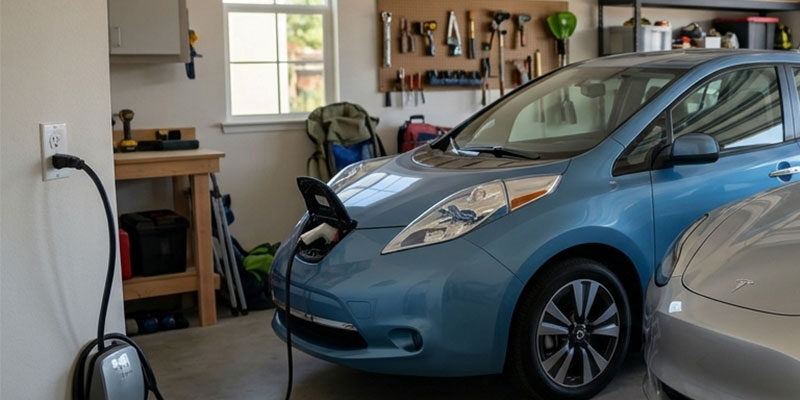
California’s push toward zero-emission vehicles is well underway, and Placer County residents are leading the charge — literally. From the suburbs of Roseville and Rocklin to the foothill communities of Auburn and Loomis, EV adoption is climbing fast. But buying the car is only step one. Once you pull into the garage for the first time, the next question hits quickly: how are you going to charge it?
Most new EV owners start with what they already have — a standard wall outlet — and quickly realize it’s not going to cut it for daily driving. Here’s what you need to know about your home charging options and how to make the right choice for your household.
Level 1 Charging: Convenient, But Limited
Level 1 charging uses a standard 120V household outlet — the same type you’d plug a lamp into. No installation required, no extra hardware. You simply plug in the cord that came with your vehicle and let it charge overnight.
The catch? At 3 to 5 miles of range per hour, a full charge can take 20 hours or more. If you’re driving 40 or 50 miles a day commuting from Auburn or Lincoln into Roseville or Sacramento, Level 1 just can’t keep up. It works fine for a vehicle that gets driven occasionally — a second car, a weekend errand runner — but for most Placer County commuters, it becomes a source of frustration fast.
Level 2 Charging: The Right Tool for the Job
Level 2 charging runs on a 240V dedicated circuit — the same voltage your clothes dryer uses. The difference in charging speed is substantial: 15 to 40 or more miles of range per hour, depending on your vehicle and the charger. In practical terms, most EVs go from nearly empty to fully charged overnight.
Level 2 also gives you access to smart-charging features, allowing you to schedule charging during off-peak hours when electricity rates are lower. It’s also roughly 10% more energy-efficient than Level 1, meaning less electricity is lost in the transfer — which adds up over time.
For most Placer County homeowners, Level 2 isn’t a luxury. It’s just the practical choice.
Choosing the Right Amperage
Not all Level 2 chargers are created equal. EVSE units typically come in 32-amp and 48-amp configurations, and the difference matters. A 48-amp charger delivers noticeably faster charging speeds — roughly 11 miles of range per hour vs. 7.5 for a 32-amp unit, though actual results vary by vehicle. The tradeoff is that a 48-amp charger requires more available capacity in your electrical panel.
Before settling on a unit, talk to your electrician about what your panel can support and whether your vehicle can even take advantage of the higher amperage. For most households, a 40-amp circuit powering a 32-amp charger hits the sweet spot between cost and performance. The U.S. Department of Energy’s Alternative Fuels Data Center has a useful breakdown of home charging options if you want to dig into the details.
What Installation Actually Involves
Installing a Level 2 charger requires a licensed electrician to run a dedicated 240V circuit from your panel to the charging location, typically in the garage. Depending on how the job is configured, this may mean installing a NEMA 14-50 outlet for a plug-in charger, or hardwiring the unit directly to the wall.
There’s a permit involved. Placer County Building Services has an expedited residential EV checklist that streamlines the process, but cities like Roseville and Rocklin may have their own specific requirements at the city level. A licensed local electrician will know which permits apply to your address and handle the paperwork.
One thing worth noting for homeowners in older foothill communities: homes in Auburn, Loomis, and similar areas sometimes have older electrical panels without enough available amperage to support a new 240V circuit. A panel assessment before installation will tell you whether you’re good to go or if an upgrade is needed first.
The Tesla Wall Connector and the Shift to NACS
If you drive a Tesla — or even if you don’t — the Tesla Wall Connector is worth knowing about. It’s a clean, wall-mounted Level 2 charger that integrates with the Tesla app and delivers fast, reliable home charging. With the shift toward the NACS (North American Charging Standard), Tesla’s connector is increasingly becoming the universal standard across multiple EV brands, making the Wall Connector a smart long-term investment for many households.
For outdoor installations, keep Placer County’s summer heat in mind. Shaded or covered mounting locations will protect your equipment and extend its service life.
Future-Proofing Your Installation
If your electrician is already running conduit for one EV circuit, it costs relatively little extra to size it for a second — useful for two-EV households, or anyone planning to add charging capacity down the road. It’s worth asking your electrician about this upfront, since retrofitting later is always more expensive than planning ahead during the initial install.
Pair Your EV Charger with Solar
Here’s where the math gets really interesting. Placer County gets abundant sunshine, and a growing number of local homeowners are combining EV charging with rooftop solar — charging during peak production hours to run primarily on power they’re generating themselves rather than drawing from the grid. Over time, the combination of solar and a smart Level 2 charger can dramatically reduce what you’re paying for both electricity and fuel.
Magic Sun Electric works closely with Magic Sun Solar — a Loomis-based solar installation company serving Placer and Sacramento Counties — to help homeowners plan EV charging and solar as a single, integrated system. If you’re considering both, getting them evaluated together makes a lot more sense than tackling them separately.
2026 Rebates and Incentives
The cost of Level 2 installation doesn’t have to come entirely out of pocket. Several programs can offset the expense:
Roseville Electric customers may qualify for a rebate of up to $500 on Level 2 EVSE equipment. PG&E’s Empower EV program offers income-qualified customers up to $2,000 toward panel upgrades needed for EV charging. At the federal level, a 30% tax credit — capped at $1,000 — is available for qualifying EV charger hardware and installation costs. Your electrician can help confirm which incentives apply to your situation.
The Bottom Line
Level 1 charging is better than nothing, but for anyone using their EV as a daily driver in Placer County, Level 2 is the standard that makes EV ownership actually convenient. A professional installation, done right the first time, means you wake up every morning to a full charge — no planning, no stress.
Ready to Get Started?
Whether you need electrical repairs, a panel upgrade, EV charger installation, lighting upgrades, or commercial electrical services, Magic Sun Electric is here to help. We serve homeowners and businesses throughout Greater Sacramento and Placer County with professional electrical services, transparent pricing, and exceptional customer satisfaction.
Call us today at 916-794-0448 for a free estimate, or contact us by email to discuss your electrical needs.
Magic Sun Electric — Licensed, Bonded & Insured (License #953640, C10 Electrical)