
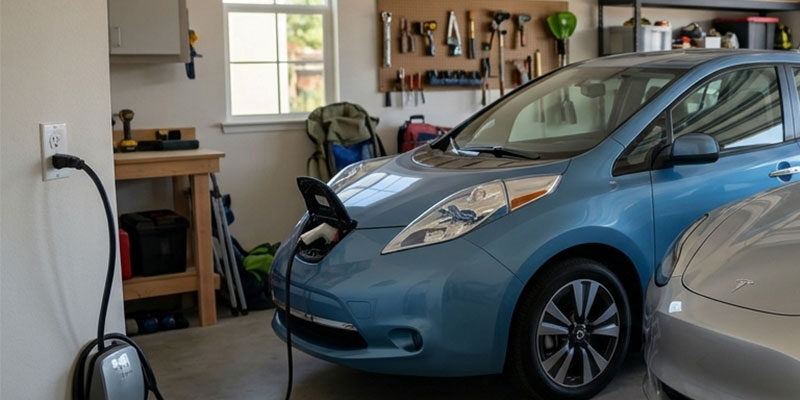
Make home charging convenient with a professionally installed EV charging station. Our licensed electricians install Level 1 and Level 2 EV chargers for Tesla, Rivian, Ford, Chevy, and all major electric vehicles. We’ll assess your electrical panel capacity, install dedicated circuits, and ensure your charging station meets all safety codes—whether you’re in Granite Bay, Lincoln, or anywhere in Greater Sacramento. Going electric has never been easier.

Magic Sun Electric Blog Post

Is Your Home Ready for an EV Charger? Complete Installation Guide for Sacramento Homeowners

You just bought your first electric vehicle—congratulations! Whether it’s a Tesla Model Y, a Ford Mustang Mach-E, a Chevy Bolt, or any of the dozens of excellent EVs now available, you’re about to experience the future of transportation. The instant torque, the smooth acceleration, the lower operating costs—it’s all exciting.

But now comes the practical question: how are you going to charge it at home?

I’m Brandon from Magic Sun Electric, and EV charger installations have become one of our most common requests over the past few years. California leads the nation in electric vehicle adoption, and here in Sacramento and Placer County, I see more EVs on the road every day. Whether you’re in Roseville, Granite Bay, Folsom, or Auburn, chances are your neighbors are already charging their EVs at home.

The good news? Installing a home EV charger is straightforward when you work with an experienced electrician. Even better news? Significant rebates are available that can dramatically reduce your installation costs. Let me walk you through everything you need to know about home EV charging—from understanding your options to navigating the installation process to taking advantage of available rebates.

Why Home Charging Matters

We expect most readers already understand the benefits of home charging, but if this is new to you, here’s why most EV owners consider home charging essential:

Convenience: Charge overnight while you sleep and start every day with a "full tank." No more trips to gas stations or public charging stations for your daily driving needs.

Cost Savings: Home electricity is significantly cheaper than public charging, especially if you charge during off-peak hours when rates are lowest. Sacramento area residents with time-of-use plans can charge for a fraction of the cost of gasoline.

Time Savings: Your time is valuable. Charging at home means no detours, no waiting at charging stations, and no planning your day around where you can plug in.

Reliability: Your charger is always there when you need it. No worrying about whether public chargers are available, working, or occupied.

Now let’s talk about what you need to make home charging a reality.

Level 1 vs. Level 2 Charging: Understanding Your Options

When it comes to home EV charging, you have two main options, and understanding the difference is crucial.

Level 1 Charging (Standard 120-Volt Outlet)

Level 1 charging uses the cable that came with your EV, plugging into any standard household outlet. It requires no special installation—just plug it in. The problem? It’s slow. Really slow.

Level 1 charging typically adds only 3-5 miles of range per hour. For most EVs with battery capacities of 60-80 kWh, a full charge could take 40-50 hours or more. If you drive 40 miles to work and back, you’d need 8-10 hours of charging just to replace what you used that day.

Level 1 charging works okay for plug-in hybrids with small batteries, or as an emergency backup option. But for most EV owners driving daily in the Sacramento area—whether commuting from Auburn to Roseville, Lincoln to Sacramento, or Folsom to Rancho Cordova—Level 1 charging is simply too slow to be practical.

Level 2 Charging (240-Volt Dedicated Circuit)

This is what most EV owners install at home, and it’s what we’ll focus on for the rest of this article. Level 2 charging uses the same 240-volt power that runs your electric dryer or range. It requires professional installation and a dedicated circuit, but the charging speed makes it worthwhile.

Level 2 charging typically provides 20-60+ miles of range per hour, depending on your charger’s power output and your vehicle’s charging capacity. This means most EVs can fully charge overnight in 6-8 hours—perfect for daily use. You come home, plug in, and wake up to a fully charged vehicle every morning.

Level 2 charging is practical for daily driving throughout the Sacramento region, supports longer commutes, future-proofs your setup as EVs get larger batteries, and adds value to your home as EV adoption continues to grow.

A Quick Note on DC Fast Charging

You’ve probably seen DC fast charging stations at shopping centers and along highways. These are commercial charging stations that can add 100-200 miles of range in 20-30 minutes. They’re great for road trips, but they’re not available for residential installation. Home charging is for your daily needs; fast charging is for those occasional long-distance trips.

For more detailed information about EV charging standards and options, the Department of Energy’s Alternative Fuels Data Center provides comprehensive resources.

Electrical Requirements: What Your Home Needs

Here’s where we get into the technical side—but don’t worry, I’ll keep it straightforward.

The Circuit

Level 2 EV chargers require a dedicated 240-volt circuit. "Dedicated" means nothing else shares that circuit—it’s exclusively for your EV charger. This is similar to how your electric dryer or range has its own dedicated circuit.

The most common installations use either a 40-amp or 50-amp circuit. The circuit size determines how fast your vehicle charges, up to the maximum charging rate your specific EV can accept.

Understanding Amperage and Charging Speed

Higher amperage generally means faster charging, but your vehicle has a maximum charge rate. For example, if your EV can only accept 32 amps of charging power, installing a 48-amp charger won’t make it charge any faster. Here are the common options:

  • 32-amp charger (requires 40-amp circuit): Good for most EVs, provides solid charging speed
  • 40-amp charger (requires 50-amp circuit): Faster charging for vehicles that support it
  • 48-amp charger (requires 60-amp circuit): For vehicles with higher charging capabilities

Many homeowners choose a 50-amp circuit even if their current vehicle doesn’t need it. This provides flexibility if you upgrade to a vehicle with faster charging capability in the future.

Panel Capacity: The Critical Question

Here’s the issue many Sacramento and Placer County homeowners face: a 40-50 amp circuit for an EV charger is a significant electrical load. Your home’s electrical panel must have available capacity to support this additional demand.

Many older homes in Carmichael, Fair Oaks, Auburn, and Orangevale were built with 100-amp electrical service. A 100-amp panel is often at or near capacity already—between your air conditioner (especially during Sacramento’s hot summers), electric range, dryer, water heater, and all your other electrical needs. Adding a 40-50 amp EV charger circuit might not be possible without upgrading to a 200-amp panel.

Quick questions to assess your situation:

  • How old is your home and electrical panel?
  • Do you already experience breaker trips occasionally?
  • What’s your panel’s amperage rating (should be marked on the main breaker)?
  • Are there empty spaces for additional breakers?

This is why a professional assessment is so important. We can evaluate your panel capacity before you buy a charger and let you know if a panel upgrade will be necessary. If an upgrade is needed, we can coordinate it with your charger installation. Learn more about our panel upgrade services on our electrical services page.

"We’ve been working with Magic Sun Electric and Magic Sun Solar for a decade now and they do excellent work. In the past, we’ve had Magic Sun Electric help us with installing a charging station in our garage and then a few years later, converting the charging to a Tesla Universal Charger. Chad responded promptly, gave me a quote and we were able to set up a day/time via text. On the day of, Jim and Nick showed up right on time and got the job done!"

— Annette H., Rocklin, CA

Where to Install Your Charger

Location matters more than you might think. Here are the key considerations:

Garage Installations (Most Common)

Installing your charger in the garage is usually the best option. It’s protected from Sacramento’s intense summer sun and winter rain, it’s convenient, and it’s typically closer to your electrical panel (which keeps installation costs down). Consider which side of the garage makes the most sense based on where your vehicle’s charge port is located.

Outdoor Installations

If you don’t have a garage, or if you prefer to park outside, outdoor installation is absolutely possible. It requires weather-rated equipment designed to handle Sacramento’s temperature extremes, and materials tend to be more expensive. Consider sun exposure (direct sun on hot summer days), security, and accessibility.

Other Considerations

Think about cable length from the charger to your vehicle’s charge port—most chargers come with 18-25 foot cables. Consider where the charge port is on your specific vehicle. If you have multiple vehicles or might add a second EV in the future, think about locations that could accommodate a second charger down the road.

Hardwired vs. Plug-In

Most installations are hardwired, meaning the charger is permanently connected to your electrical system. Some chargers offer a plug-in option using a special 240-volt outlet (similar to your dryer outlet). We can help you decide which approach makes sense for your situation.

Understanding Charger Features

Rather than recommending specific brands or models, let me explain the features you should consider. Our team at Magic Sun Electric will guide you through the options and help you select a charger that fits your vehicle, budget, and charging needs.

Smart Features: Many modern chargers offer WiFi connectivity, smartphone apps for monitoring and scheduling charges, energy usage tracking, and even voice control integration. These features can help you take advantage of lower off-peak electricity rates by scheduling charging for specific times.

Charging Power: Look for chargers with adjustable amperage settings. This gives you flexibility if you upgrade to a vehicle with different charging capabilities later.

Cable Length: Most chargers come with 18-25 foot cables. Consider your parking situation and your vehicle’s charge port location when deciding what cable length you need.

Connector Type: Most non-Tesla EVs use the J1772 connector, which is the universal standard. Tesla vehicles can use either the Tesla Wall Connector or any universal J1772 charger with the adapter that comes with your Tesla. If you have a Tesla, either option works well—we can help you decide based on your specific situation and whether you might have non-Tesla EVs in the future.

Durability and Safety: Look for UL-listed equipment, appropriate weather resistance ratings for your installation location, and solid manufacturer warranties. These aren’t areas where you want to cut corners.

The Installation Process

Here’s what to expect when you work with Magic Sun Electric for your EV charger installation:

Step 1: Assessment and Planning We start by evaluating your electrical panel’s capacity and condition, determining the best location for your charger, calculating the wire run distance, and providing a detailed, transparent estimate.

Step 2: Equipment Selection We’ll discuss charger features and help you understand your options. We’ll recommend an appropriate circuit size based on your vehicle and needs, and we can either help you select a charger or install one you’ve already purchased.

Step 3: Permitting EV charger installations require electrical permits in Sacramento and Placer County. We handle all the permit paperwork, submit plans to the building department, and coordinate the required inspections.

Step 4: Installation On installation day, we install the new 240-volt circuit from your panel to the charger location, mount the charger (or install the outlet for plug-in style chargers), connect everything, test the system thoroughly, and verify proper operation with your vehicle. Most installations are completed in a single day.

Step 5: Inspection A city or county electrical inspector will verify the installation meets all code requirements and safety standards. We coordinate this inspection and ensure everything passes the first time.

The timeline from assessment to installation is typically 1-2 weeks, with the actual installation usually completed in one day. Permitting can add some time to the schedule, but we manage that process for you.

Costs and Rebates: Making EV Charging Affordable

Let’s talk about the investment involved—and more importantly, the significant rebates available that make home EV charging much more affordable than many people realize.

Installation Costs

Installation costs vary based on several factors: distance from your panel to the charger location, whether your panel needs upgrading, whether we need to trench for underground conduit, wall penetrations required, and overall installation complexity.

Simple installations—garage location near your panel with straightforward access—are the most affordable. More complex installations with long wire runs or panel upgrades cost more, but remember: you’re making a long-term investment that adds value to your home and saves money every time you charge instead of buying gasoline.

The Great News: Significant Rebates Are Available

Here’s where it gets exciting. Multiple rebate and incentive programs can dramatically reduce your out-of-pocket costs:

Federal Tax Credit: The Inflation Reduction Act provides a 30% federal tax credit on EV charger installation costs, including both equipment and installation labor, up to certain limits. This alone can save hundreds or even over a thousand dollars depending on your installation.

California State Programs: Various state programs offer rebates depending on your income level and location. These can provide substantial additional savings.

Utility Company Rebates: SMUD (Sacramento Municipal Utility District) customers can access EV charger rebates. PG&E customers in parts of Placer County have their own programs. Check with your utility provider for current offerings.

Income-Qualified Programs: Low and moderate-income households may qualify for enhanced rebates that can reduce costs even more significantly.

Example Savings Scenario: An installation that costs $2,500 could see a $750 federal tax credit (30%), plus potentially $500 in utility rebates, reducing your actual cost to $1,250—half of the initial price.

Important Notes: Rebate programs and amounts change periodically, so always check current offerings when planning your installation. Some programs require using specific equipment or certified installers. Magic Sun Electric stays current on available programs and can guide you through the application process to maximize your savings.

Visit our Rebates & Incentives page for current information, and check resources like the California Clean Vehicle Rebate Project for the latest programs.

Sacramento & Placer County Considerations

Working throughout the greater Sacramento area, I’ve learned that several local factors affect EV charger installations:

Hot Summers: Sacramento’s 100+ degree summer days mean chargers that are already generating heat during operation face additional thermal stress. Proper ventilation is important for outdoor installations, while garage installations naturally stay cooler.

Older Homes: Many beautiful homes in Auburn, Fair Oaks, Carmichael, and Orangevale were built long before EVs existed. These homes often have 100-amp panels that can’t support EV charging without upgrades. Panel upgrades are common with EV charger installations in older neighborhoods—plan for this possibility when budgeting.

Growing EV Adoption: California leads the nation in EV ownership, and Roseville, Granite Bay, Folsom, and the entire Sacramento region are seeing rapid EV adoption. Home charging infrastructure is becoming a genuine selling point for homes. This is a forward-thinking investment in your property.

Utility Service Territories: SMUD customers and PG&E customers have different rebate programs available. Additionally, time-of-use electricity rates vary by utility. Off-peak charging (typically overnight) is usually the most cost-effective.

Commute Distances: Many Sacramento area residents have significant commutes—Auburn to Roseville, Lincoln to Sacramento, Folsom to downtown. Home charging with Level 2 ensures you start each day with a full charge, eliminating range anxiety and making your daily commute worry-free.

Future-Proofing: Two-car households are increasingly going dual-EV. Installing adequate panel capacity now makes adding a second charger much easier later. Consider running conduit for a potential second charger location even if you don’t need it immediately.

"I called three local electricians and all said they were too busy. Called Chad at Magic Sun and he had a repairman out in hours. Really good people and fair prices."

— Jack Bachelder, Google Review

Permits, Code Compliance, and Why They Matter

Some homeowners are tempted to skip permits or hire unlicensed installers to save money. This is a mistake that can cost you far more in the long run.

Electrical permits are required by law for EV charger installations in Sacramento and Placer County. They ensure your installation meets safety standards and electrical code requirements. Proper permits are important for insurance coverage—if an electrical fire occurs and the installation wasn’t permitted, your insurance may not cover damages. Code-compliant installation is critical for home resale—unpermitted work can cause serious problems when selling your home.

Magic Sun Electric handles all permit applications, submits required documentation to building departments, schedules inspections, coordinates with inspectors, and ensures everything passes the first time. We’re a licensed C10 electrical contractor, and every installation we complete meets or exceeds code requirements.

How Magic Sun Electric Makes EV Charger Installation Easy

With my C10 electrical contractor license and NABCEP certification, I’ve installed dozens of EV chargers throughout Sacramento and Placer County. We stay current on the latest equipment, rebate programs, and code requirements. Our goal is to make the process simple and stress-free for you.

We Provide Free Assessments: We’ll evaluate your panel capacity, assess installation location options, provide a transparent estimate, and explain any panel upgrade needs—all at no charge.

Expert Guidance Throughout: We help you understand charger features, recommend appropriate circuit sizes, navigate rebate applications, and answer all your questions with clear, honest information.

Professional Installation: Our licensed, experienced electricians use quality materials, deliver clean and efficient installation, and treat your property with respect.

Complete Project Management: We handle all permits and inspections, coordinate with building inspectors, ensure code compliance, and thoroughly test and verify operation.

Ongoing Support: We’re available to answer questions after installation, help troubleshoot any issues, and provide service for all your future electrical needs.

We serve homeowners throughout Sacramento and Placer County—from Sacramento to Auburn, Roseville to Folsom, Lincoln to Rancho Cordova, and everywhere in between. Whether you just bought your first EV or you’re adding a charger to your existing home, we’ll make sure your installation is done right.

Learn more about our complete range of electrical services on our electrical services page, or visit our FAQ & Resources for additional information.

Join the EV Revolution With Confidence

Owning an electric vehicle is an exciting step toward cleaner, more sustainable transportation. Home charging makes EV ownership practical, convenient, and cost-effective. With professional installation, you’ll enjoy reliable charging that works perfectly from day one. And with the rebates currently available, home EV charging is more affordable than many Sacramento area homeowners realize.

Thinking about adding an EV charger to your Sacramento or Placer County home? Let’s start with a free assessment of your electrical system. We’ll evaluate your panel capacity, discuss location options, explain your costs with available rebates factored in, and provide honest, professional guidance about what’s involved.

There’s no pressure and no obligation—just straightforward information from experienced professionals who’ve done hundreds of these installations.

Call Magic Sun Electric at (916) 794-0448 or contact us online to schedule your free assessment. Let’s get you charging at home and enjoying all the benefits of electric vehicle ownership.

Join the growing number of Sacramento area homeowners enjoying the convenience and cost savings of home EV charging. We’ll make sure your installation is done right, safely, and with all available rebates applied.


Brandon is a C10 licensed electrical contractor (License #953640) and NABCEP certified professional with Magic Sun Electric. With extensive experience installing EV chargers throughout Sacramento and Placer County, he helps homeowners make the transition to electric vehicle ownership smooth and worry-free.